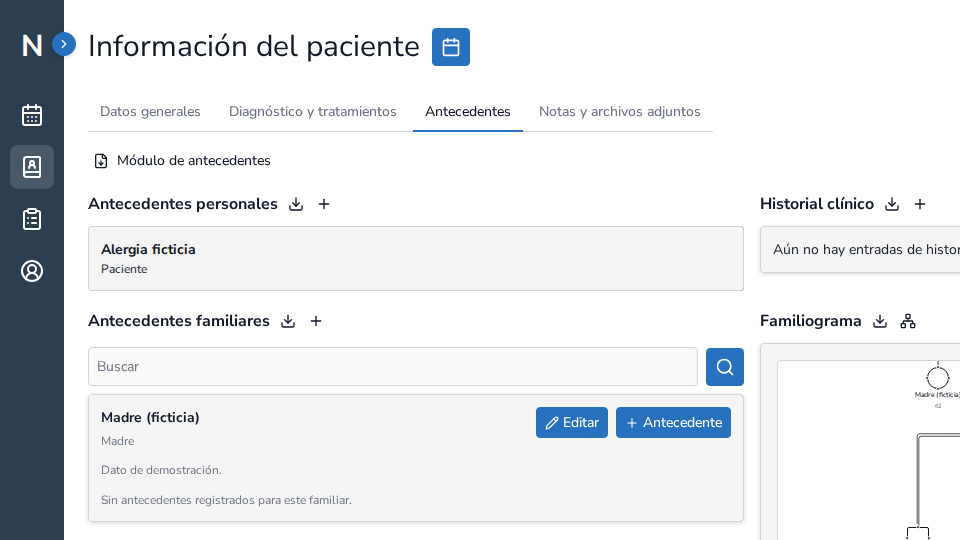
A familiogram can represent people, relationships, and selected family background within the context of a client record. It is not an automatic clinical conclusion: it is a way to organize information that the professional chooses to record and review.
What a familiogram means operationally
In a digital tool, a familiogram can represent person nodes and relationships between them. The labels, level of detail, and interpretation depend on the professional context.
Define the scope before building it
- Which people are relevant to the case you need to review.
- What relationship each person has to the client.
- Which information is necessary and which is unnecessary.
- How to distinguish a recorded relationship from a professional interpretation.
- Who can view or export the information.
A maintainable structure matters. A small, clear diagram that is updated can be more useful than a detailed diagram that no one can review consistently.
A completely fictional example
An editorial capture can use a fictional client and a simple network: client, mother, father, sibling, partner, and child. The labels and relationships exist only to demonstrate the interface. They must not be presented as a real case or a universal family-assessment example.
Review it inside the record
A practical review can start in the background tab, confirm the correct client, and check that the visible relationships match what the professional chose to record. NeuraClinic lets the familiogram sit alongside other case sections; it does not decide what the representation means.
What software should not claim
A digital familiogram does not diagnose, recommend interventions, or replace an interview or professional judgment. A drawn relationship is not automatically a clinical fact. Claims about theory, assessment, or clinical use require human review and appropriate sources.
For broader context, read how to organize a psychology client record and explore NeuraClinic clinical records.